How to Manufacture Furniture From Idea to Freight
How to manufacture furniture explained, from materials, methods, and tooling to sampling, freight, and the factory access that turns an idea into real product.
A three foot side table shaped like a pill bottle. That is the object Oskar Flodstrom bent out of a sheet of acrylic he found on the side of the road in Los Angeles. He posted the build, it did half a million views, and a few months later the same shape was rolling off a real production line as a 225 dollar product under his brand erik oskr. Nothing about that is magic. It is just the furniture manufacturing process, and once you see how the steps fit together it gets a lot less intimidating.
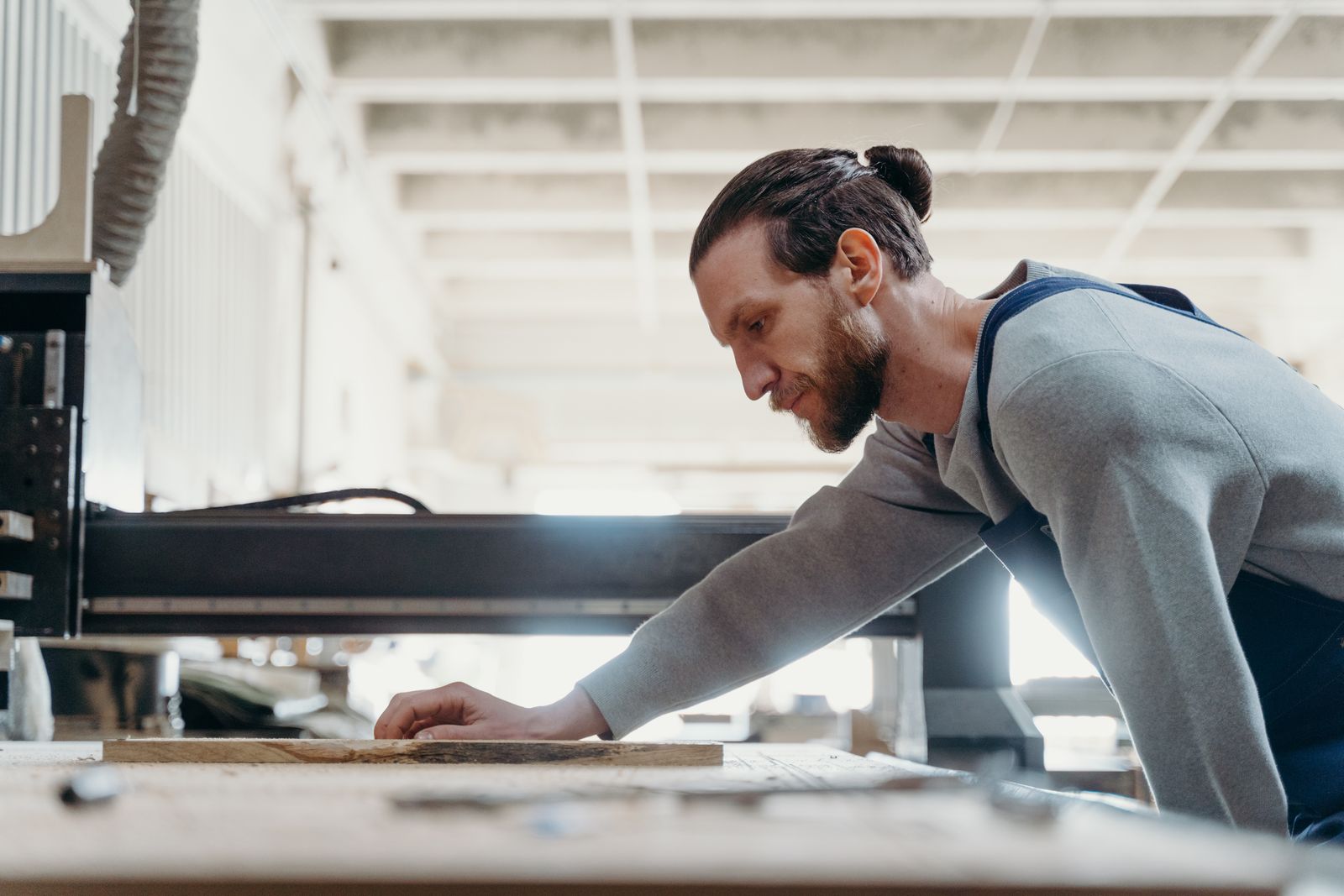
A worker shaping stock on the factory floor, where most of the real furniture making happens.
Manufacturing furniture is a chain of decisions. Material, method, tooling, sample, production, freight. Get each one right and you have a product. Get the factory relationship right and the rest gets faster. No Logo was partly built by founders who ran a direct from factory furniture brand, so this is home turf.
Material decides everything else
Every downstream choice traces back to what the piece is made of. Furniture works mostly in wood, metal, plastic, glass, foam, and fabric, and each carries its own tools, labor, and cost curve.
Wood is the big one. Solid hardwood and softwood for structure and show surfaces, then engineered boards like plywood, MDF, and particle board for panels and hidden framing. Engineered board is cheaper, flatter, and more stable across humidity swings, which is why so much affordable furniture uses it under a veneer. Metal shows up as frames, legs, and brackets, usually steel or aluminum. Plastic and acrylic cover molded shells and translucent pieces, the family Oskar's pill bottle table lives in. Then the soft side, foam and fabric and leather for anything upholstered.
Material also drags a regulatory tail behind it. The EU now caps formaldehyde emissions from wood based furniture, and rules on flame retardants and PFAS in upholstery keep tightening. If you plan to sell across borders, the board and foam you pick can quietly decide which markets you are allowed in.
Method follows material
Once the material is set, the making method mostly picks itself, and most real pieces mix machine and hand work. CNC routers cut and shape wood and panel stock with a precision no hand tool matches. Panels get sawn and edge banded, metal frames get welded or bolted, molded parts get formed. On the human end, upholstery is still sewn and stretched by hand, and final assembly and finishing lean on skilled labor. A single dining chair might touch a CNC machine, a welding jig, a sander, and four sets of hands before it is boxed. That blend is why furniture pricing swings so hard between a flat pack panel piece and a hand upholstered one.
Tooling and molds, and when you actually need them
Founders talk themselves out of good products assuming every piece needs an expensive custom mold. Most do not. If your piece is cut, joined, and finished from stock material, a wood table, a metal frame chair, a shelving unit, there is no mold at all. The tooling is the CNC program, the cutting jigs, and the assembly fixtures, all cheap and fast to change between sample rounds.
Molds only enter when you are forming a material into a repeated shape. Thermoforming, which heats a plastic or acrylic sheet and pulls it over a form, is the low cost path, with tooling commonly in the 4,000 to 7,000 dollar range. Injection molding is the other end. It buys a far lower cost per part at scale, but a production steel mold runs roughly 15,000 to 80,000 dollars and only pays off past a few thousand units. Below that, thermoforming or straight fabrication almost always makes more sense. Knowing which bucket your idea falls into is most of the battle.
Sampling is where the product becomes real
You do not go from sketch to a warehouse full of inventory. You go through samples. A sample is the first physical build of your piece, made so you can hold it, sit on it, wobble it, and find everything the drawing hid.
This is the step Oskar went through. He submitted his idea, and instead of wiring money for tooling and praying, the factory network built the sample and delivered the finished piece back to him. No capital out of his pocket, no minimum order, no risk. First samples almost never come back perfect. You will adjust a joint, a radius, a foam density, a finish. Two or three rounds is common, and it is far cheaper to fix a chair in sampling than in a shipping container.
That no obligation sample start is the whole point. Start a project and No Logo will build a real piece you can hold before any money goes to production.
The freight reality nobody warns you about
Furniture is bulky, and bulk is the tax that catches people off guard. A sofa can cost more to ship than a pallet of bricks six times its weight, because freight on light large items is priced by the space it eats in the trailer, not the pounds on the scale.
Domestic furniture mostly moves by less than truckload freight, and a single pallet on a short run might be 250 to 300 dollars before accessorials. Residential delivery, a liftgate, and inside delivery each stack on more, and a heavier item cross country can run from 350 to well over 1,500 dollars. None of this kills the model. It just means freight has to live in your price from day one, not get discovered after launch. Flat pack designs exist largely because a piece that ships smaller ships cheaper.
Why factory access is the whole game
You can learn every step above and still get stuck for a year. One brand came to No Logo after a full year hunting for the right factory for a pants project. Because we have people on the ground in China and a vetted factory network, we sourced and produced that founder's next product, a hoodie, in about two weeks. The knowledge is learnable. The relationships are not, at least not quickly.
That is the actual thing being sold here. Not just manufacturing, but the years of factory access, vetting, and presence a founder cannot build alone. No Logo runs on a flat 25 percent production margin with no upfront inventory commitment, and the creator keeps full control of the brand and the pricing. Oskar's pill bottle side table went from a roadside acrylic build to 150,000 dollars in sales in two weeks because he plugged into that access instead of trying to recreate it from a 120 square foot room.
The furniture is the easy part. Cut, join, form, finish, sample, ship. To go deeper on the business around it, read how to start a furniture brand, see the full erik oskr story, or learn how to find a factory overseas without getting burned. Start a project when you are ready to make one.